EBS To Cloud Migration
ONAS follows a structured, professional view of Oracle EBS to Oracle Fusion Cloud migration.
Oracle EBS to Oracle Fusion Cloud migration is a business transformation initiative, not merely a technical upgrade.
- It involves:Process redesign
- Cloud architecture adoption
- Data modernization
- Integration re-engineering
- Governance and control enhancement
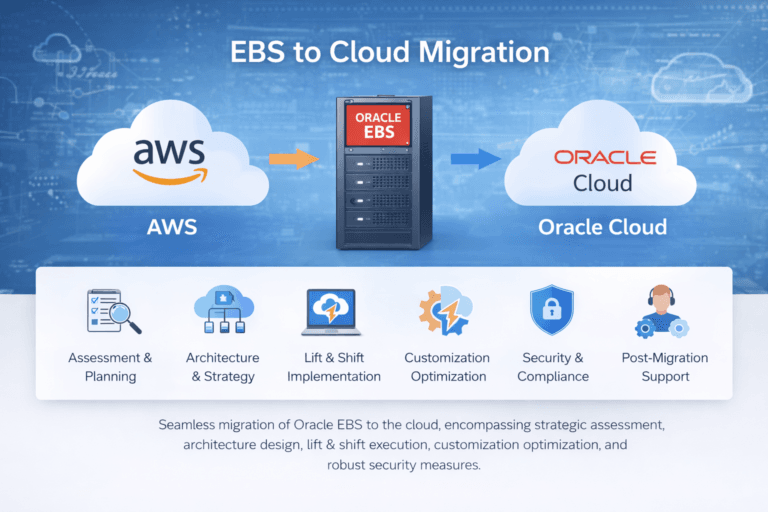

At ONAS, we deliver a structured and business-focused approach to Oracle EBS to Oracle Fusion Cloud migration. Our methodology ensures reduced risk, minimal downtime, and a smooth transition to a scalable, secure cloud environment.
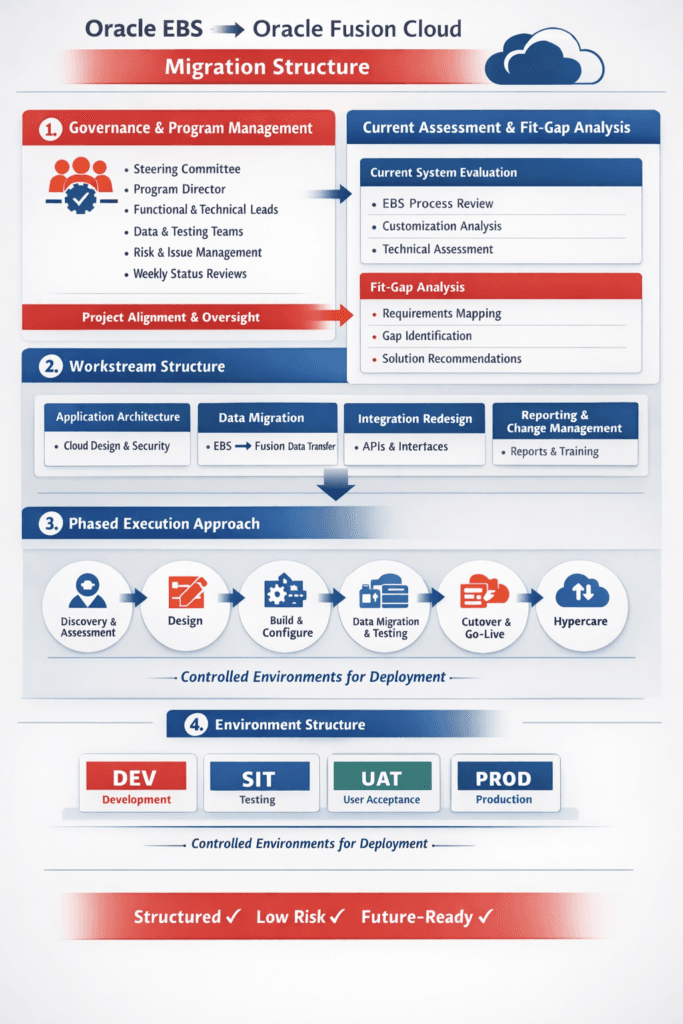
Our high-level migration framework includes:
- Discovery & Assessment – Evaluate the current EBS environment, customizations, integrations, and risks.
- Future-State Design (HLD) – Define the target Fusion Cloud architecture and optimized business processes.
Build & Configuration – Configure Fusion modules aligned with business and compliance requirements.
Data Migration & Integration – Cleanse, transform, and migrate data while ensuring seamless integrations.
Testing & Validation – Conduct SIT, UAT, and performance testing for accuracy and reliability.
Cutover & Go-Live – Execute a controlled deployment with minimal business disruption.
Hypercare & Stabilization – Provide post-go-live support, monitoring, and optimization.
With ONAS, migration is not just a system upgrade — it is a strategic transformation toward agility, efficiency, and long-term cloud success.
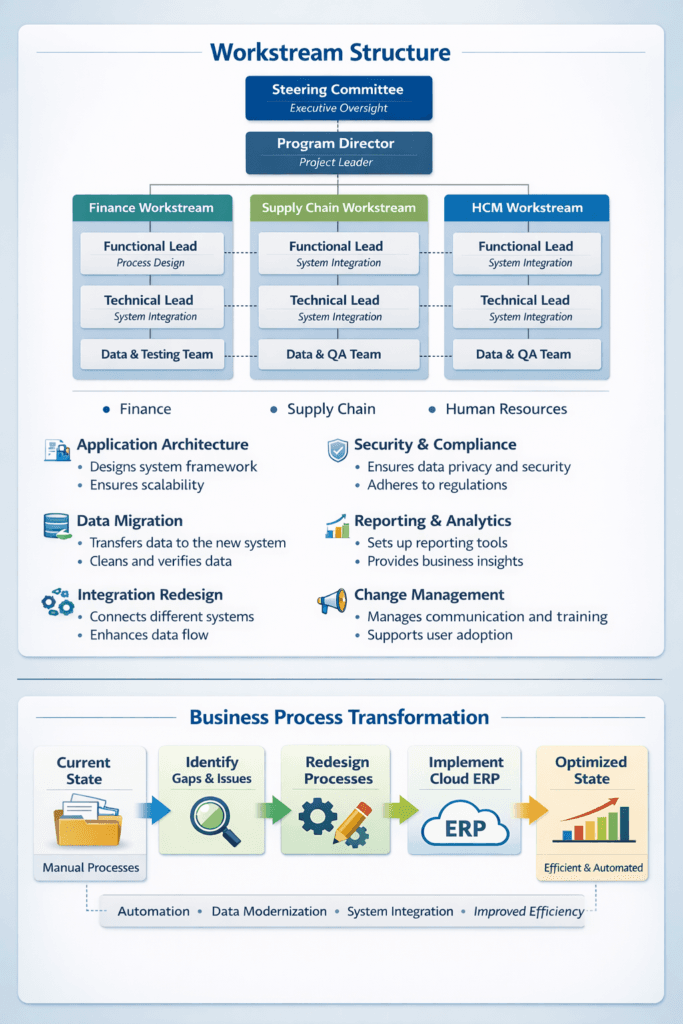
Business Process Transformation
- As-Is process documentation
- gap workshops
- To-Be process design
- Control framework alignment
Application Architecture
- Fusion module selection
- Environment strategy (DEV / TEST / PROD)
- Integration architecture
- Reporting architecture
Data Migration
- Master data strategy
- Open transaction migration
- Historical data decision
- Reconciliation framework
Integration Redesign
- API-based integrations
- Oracle Integration Cloud (OIC) usage
- Bank interfaces redesign
- External system mapping
Security & Compliance
- Role-based access control
- Segregation of Duties (SoD)
- Workflow approvals
- Audit logging
Reporting & Analytics
- OTBI & BI Publisher
- Financial Reporting Studio
- KPI redesign
- Regulatory reporting
Change Management
- Stakeholder engagement
- Training programs
- Communication plan
- Adoption monitoring
Governance & PMO
- Steering committee
- Risk log
- Issue management
- Change control board
At ONAS, we deliver a structured and outcome-driven migration framework for Oracle ERP transformations.
Our approach ensures a smooth transition from legacy systems to cloud platforms with minimal business disruption, strong governance, and long-term scalability.
We focus on assessment, optimization, and strategic alignment to maximize business value.

- This structured evaluation ensures optimized cloud adoption with reduced complexity and improved operational efficiency.
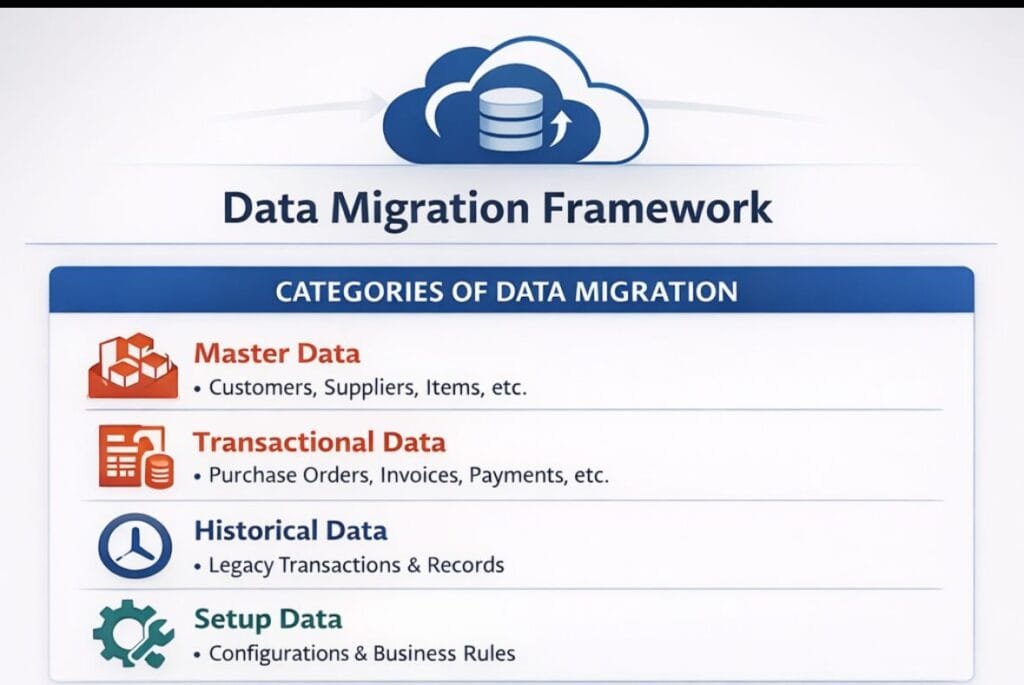
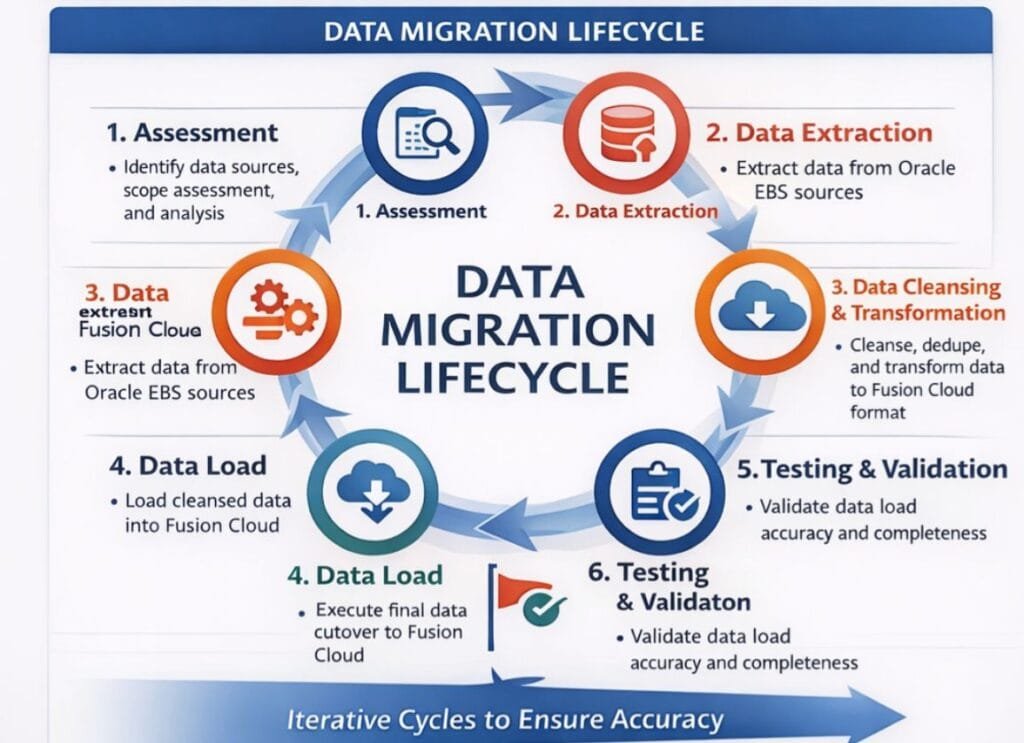
At ONAS, we deliver a structured and reliable Data Migration Framework to ensure accurate, secure, and seamless movement of data from legacy systems to cloud platforms. Our approach focuses on data quality, reconciliation accuracy, and business continuity during migration

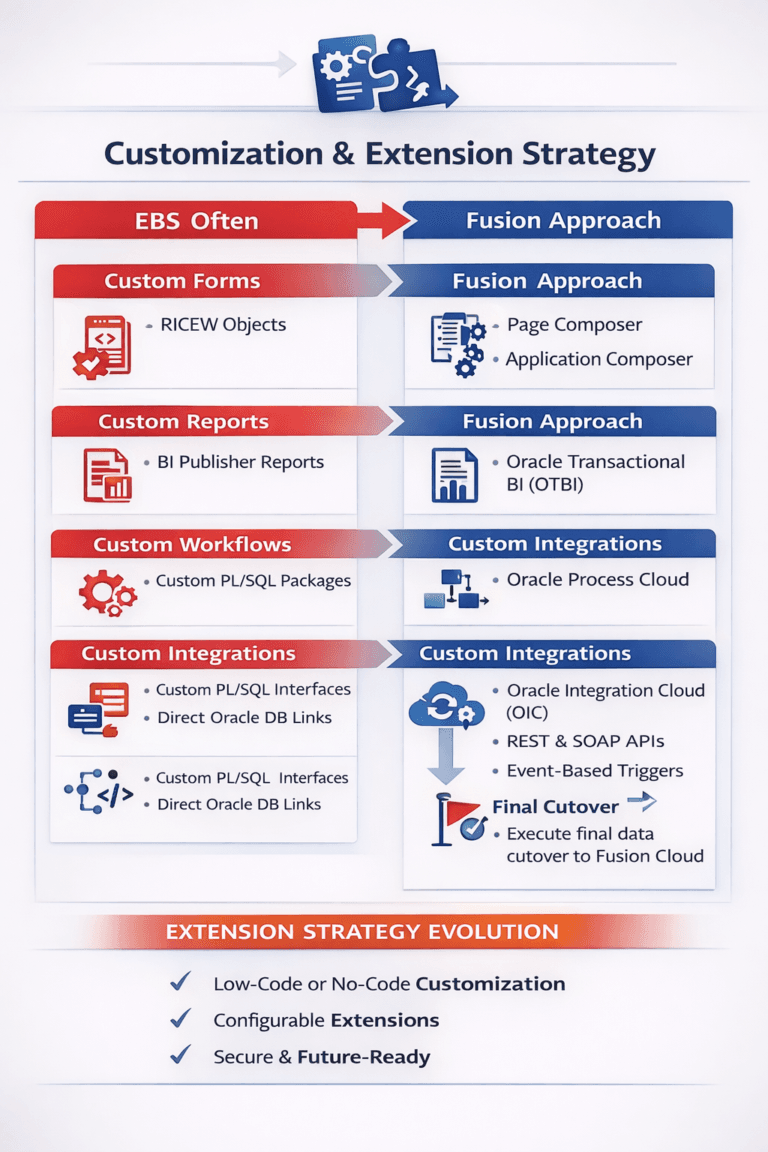
At ONAS, we deliver a structured Customization and Extension Strategy to help organizations smoothly transition from Oracle EBS to Oracle Fusion Cloud.
We analyze existing custom components in EBS and redesign them using Oracle Fusion’s modern, cloud-based extensibility tools. Our goal is to minimize risk, reduce technical debt, and adopt best-practice cloud standards.

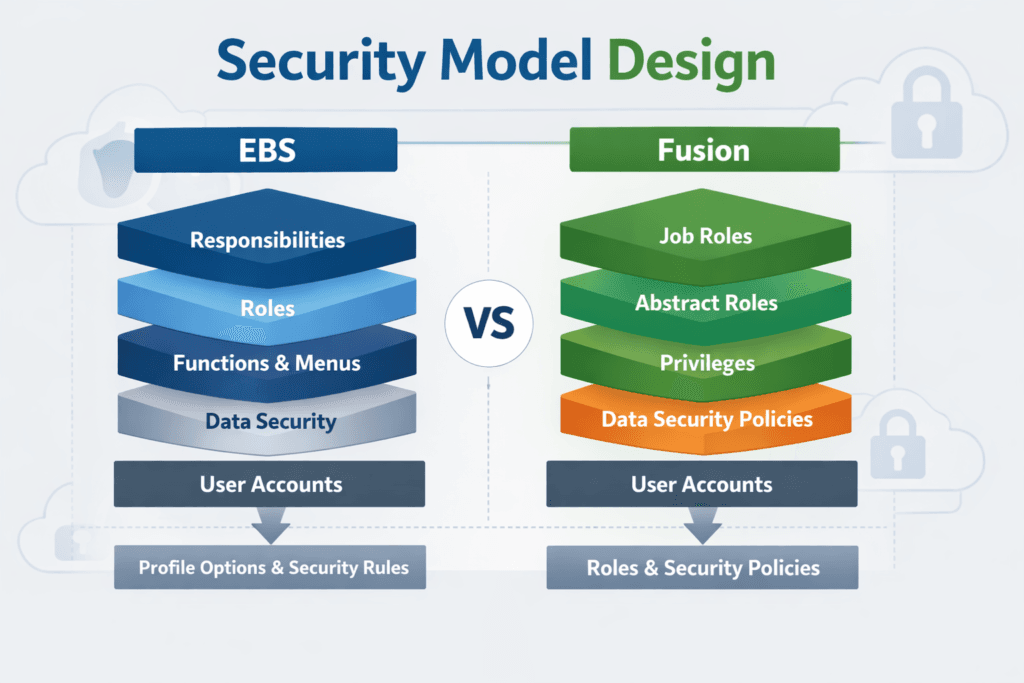
At ONAS, we deliver comprehensive Security Model Redesign services as part of Oracle ERP transformation programs. We help organizations transition from traditional access structures to a modern, secure, and compliant role-based framework.

EBS Security Model:
In Oracle EBS, security is Responsibility-Based.
Users are assigned responsibilities that control access to forms,menus, and functions.
EBS:
Responsibility-based
Fusion: Role-Based Access Control (RBAC)
Fusion Security Model:
In Oracle Fusion Cloud, security follows Role-Based Access Control (RBAC).
Access is structured in layered roles to provide better control, segregation of duties, and compliance.
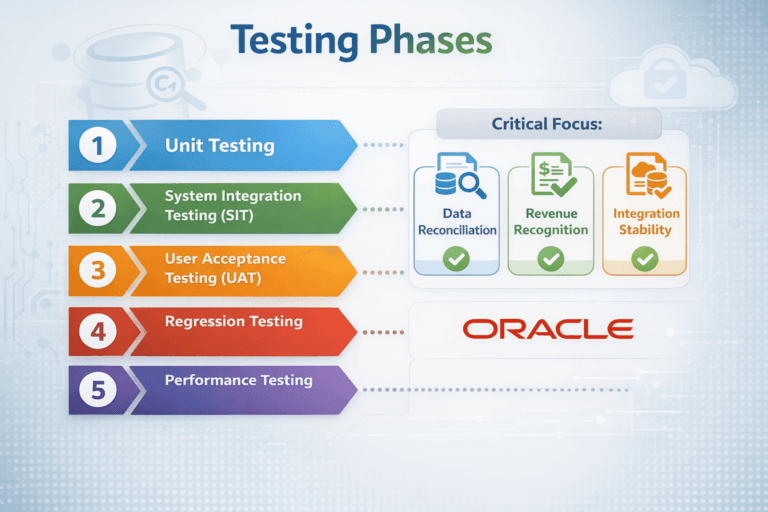
At ONAS, we deliver a structured and comprehensive Testing Strategy to ensure a smooth and risk-free Oracle transformation. Our approach focuses on validating system functionality, integrations, performance, and business process accuracy before go-live.

- Unit Testing – Validate individual configurations and components.
- System Integration Testing (SIT) – Test end-to-end business processes and integrations.
- User Acceptance Testing (UAT) – Business users validate real-time scenarios.
- Regression Testing – Ensure new changes do not impact existing functionality.
- Performance Testing – Verify system speed, stability, and load handling.
- Data Reconciliation – Ensure accurate data migration and financial balance validation.
- Revenue Recognition – Validate compliance with accounting standards.
- Integration Stability – Confirm smooth data flow between systems.
- ONAS ensures every phase is carefully executed to deliver a stable, secure, and high-performing system at go-live.
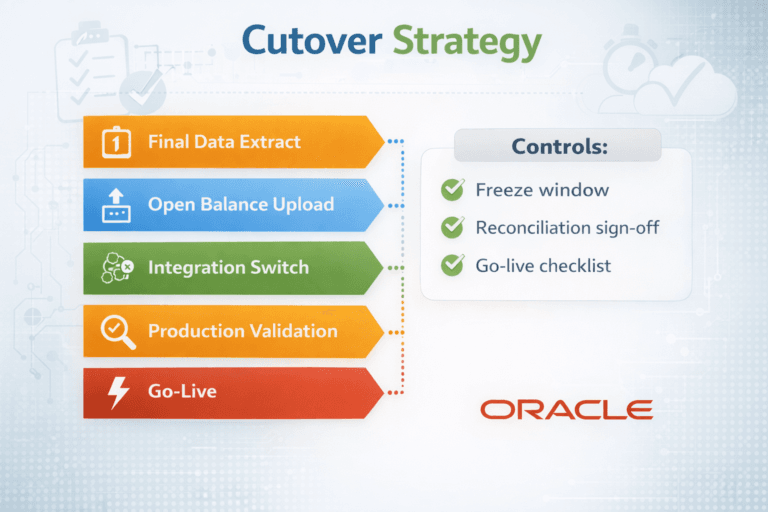
At ONAS, we follow a well-planned Cutover Strategy to ensure a smooth and controlled transition from legacy systems to Oracle Fusion Cloud. Our approach minimizes business disruption and ensures accurate data migration during go-live
- Final Data Extract – Extract latest and accurate data from the legacy system.
- Open Balance Upload – Load financial balances and open transactions into Fusion.
- Integration Switch – Redirect integrations from old system to the new system.
- Production Validation – Validate transactions and key reports in production.
- Go-Live – Officially transition business operations to the new system
- Freeze Window – Restrict system changes during cutover period.
- Reconciliation Sign-off – Confirm data accuracy and financial balances.
- Go-Live Checklist – Ensure all critical steps are completed before launch.
- ONAS ensures every cutover step is carefully monitored, validated, and approved to deliver a smooth and successful go-live.
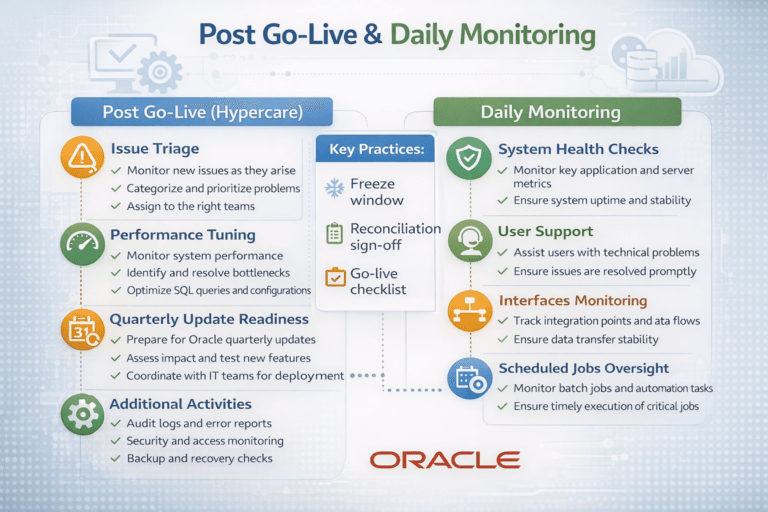
At ONAS, we deliver dedicated Post Go-Live Hypercare Support to ensure system stability and smooth business operations after implementation. Our team closely monitors the system and provides immediate support during the critical stabilization period


- Daily Monitoring – Track system transactions, integrations, and reports to ensure smooth operations.
- Issue Triage – Quickly identify, prioritize, and resolve functional or technical issues.
- Performance Tuning – Optimize system performance and improve response times.
- Quarterly Update Readiness – Prepare and validate system updates to ensure smooth cloud releases.
- ONAS ensures strong support during the hypercare phase, helping organizations achieve a stable, optimized, and fully operational system.
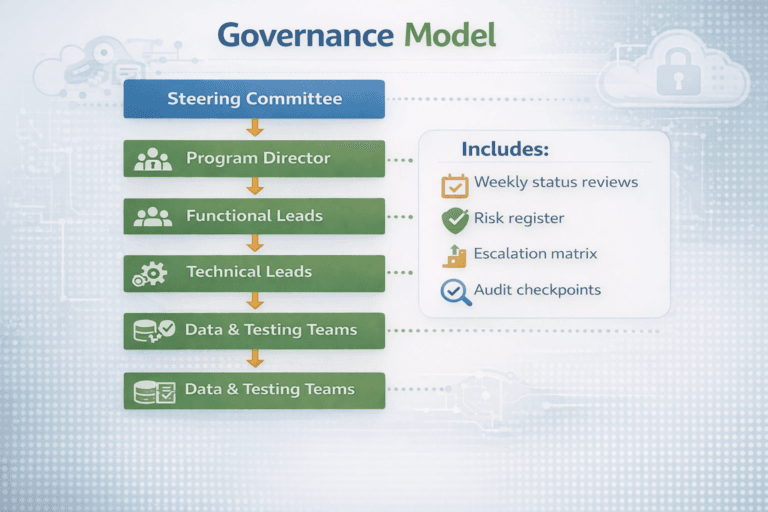
At ONAS, we deliver a structured and transparent Governance Model to ensure successful Oracle EBS to Oracle Fusion Cloud transformation. Our governance framework provides clear leadership, defined accountability, and smooth project execution from start to finish.
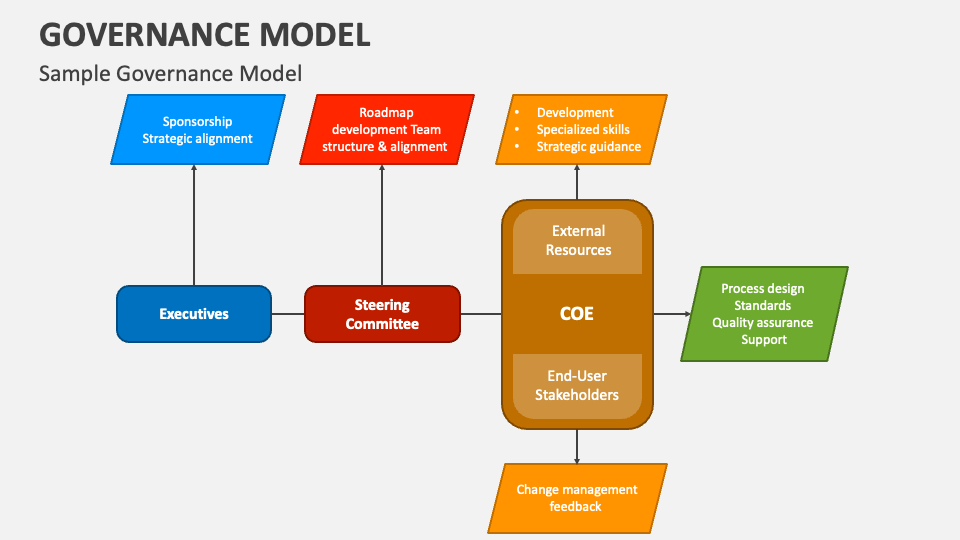
Governance Structure:
- Steering Committee
Provides strategic direction, approves key decisions, and ensures alignment with business goals. - Program Director
Leads the overall program, manages delivery timelines, budget, and stakeholder communication. - Functional Leads
Drive business process design, configuration, and ensure functional requirements are met. - Technical Leads
Manage integrations, data migration, extensions, and technical architecture. - Data & Testing Teams
- Handle data validation, system testing, user acceptance testing (UAT), and quality assurance
- Weekly Status Reviews – Regular progress tracking and stakeholder updates
- Risk Register – Identification and proactive mitigation of project risks
- Escalation Matrix – Clear issue resolution hierarchy
- Audit Checkpoints – Compliance validation and quality control reviews